 QiMeal
Crème Caramel
Crème Caramel · ready in 5 h 53 min · 8 servings · 259 kcal per serving · medium · 5 ingredients
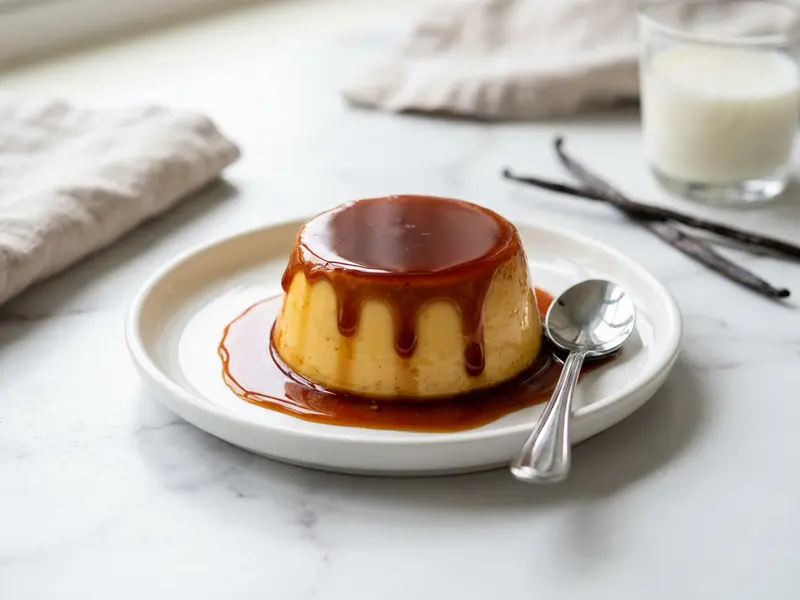
A classic French custard turned out onto a plate, with bittersweet caramel melting into a glossy sauce over a silky egg and milk base.
- Prep
- 25 min
- Cook
- 5 h 28 min
- Total
- 5 h 53 min
- Serves
- 8
- kcal
- 259
- Difficulty
- medium
Ingredients · 8 servings
- 150 gSugar, for caramel
- 1000 mlMilk, whole
- 6Egg, large
- 100 gSugar, for custard
- 2 tspVanilla extract
Equipment
stovetop, oven, refrigerator, ramekin, roasting pan, saucepan, whisk, mixing bowl, fine sieve, ladle, kitchen towel, kettle
Instructions
- Mise en place
Gather 8 ramekins, a roasting pan, saucepan, whisk, bowl, sieve, ladle, towel, and measure every ingredient before heating. · 5 min
What to look for: All ingredients are measured and tools are within reach.
- Make caramel
Heat 150 g sugar in a dry saucepan over medium heat, swirling the pan until it melts into a deep amber caramel. · 8 min
What to look for: The sugar is fully melted and deep amber, with no dry crystals.
- Coat ramekins
Pour the hot caramel at once into 8 ramekins, tilting each dish to coat the base before the caramel firms. · 2 min
What to look for: Each ramekin has a thin amber layer on the bottom.
- Warm milk
Warm the milk with vanilla extract over medium heat until steaming, then remove it from the heat before it boils. · 5 min
What to look for: Steam rises from the milk and small bubbles gather at the edge.
- Temper custard
Whisk the eggs with 100 g sugar in a bowl until smooth, then slowly whisk in the hot milk to temper the custard. · 4 min
What to look for: The mixture is smooth, pale, and lightly foamy.
- Strain custard
Strain the custard through a fine sieve, then divide it gently among the caramel lined ramekins. · 3 min
What to look for: The ramekins are evenly filled with a smooth custard mixture.
- Prepare oven
Preheat the oven to 160°C / 320°F and set a folded towel in a roasting pan to steady the ramekins. · 3 min
What to look for: The oven is heated and the towel lies flat in the pan.
- Set water bath
Place the filled ramekins in the pan, then add hot water around them until it reaches halfway up the sides. · 4 min
What to look for: Hot water surrounds the ramekins without splashing into the custard.
- Bake custards
Bake the custards in the water bath for 40 to 45 minutes, until the edges are set and the centers wobble gently. · 45 min
What to look for: The edges look set and the centers move like soft jelly.
- Cool and chill
Cool the ramekins to room temperature, then cover and chill for at least 4 hours so the caramel loosens into sauce. · 4 h 30 min
What to look for: The custards are cold, firm, and lightly glossy on top.
- Unmold and serve
Run a thin knife around each custard, invert onto plates, and serve with the caramel sauce flowing over the top. · 4 min
What to look for: The custard releases cleanly and caramel pools around it.
Nutrition (per serving)
| kcal | 259 |
|---|---|
| Protein | 9 g |
| Carbohydrates | 38 g |
| of which sugars | 38 g |
| Fat | 8 g |
| of which saturated | 4 g |
| Fibre | 0 g |
| Sodium | 107 mg |
Nutri-ScoreC
Allergens
Contains: milk, eggs
Storage and reheating
- Fridge: up to 3 days
- Freezer: not recommended
- Serve chilled and do not reheat, because heat can make the custard weep.
Ingredient substitutions
Sugar
- Caster sugar: Melts evenly and keeps the caramel classic.
Milk
- Whole milk: Best for the traditional creamy set.
Egg
- Large egg: Use eggs of similar size for a reliable custard.
Sugar
- Caster sugar: Dissolves quickly into the egg mixture.
Vanilla extract
- Vanilla: Use scraped vanilla for a traditional speckled custard.